

In this story ▾
- When to walk: the menu, the budtender, the in-store special
- When to order delivery: time, privacy, and the known re-order
- The neighborhood-by-neighborhood reality
- Money: walking vs. delivery cost reality
- Where to shop: the named-licensed-shop file
- The walking-delivery hybrid: building a routine
- Compliance: the OCM QR and the licensed-only frame
- FAQ
# Manhattan Cannabis Delivery vs. Walking to a Licensed Shop: A Cannabis-Aware Decision Tree for Adults 21+
Manhattan packs more OCM-licensed cannabis shops into a few square miles than any other slice of New York. For adults 21 and over, the practical question isn't whether to buy legal cannabis. It's whether to walk to a shop or have it delivered. Both routes are legitimate. Both come with trade-offs that rarely get explained on a service-ranking page.
The honest answer depends on what someone wants from the transaction. A Tuesday-night restock of a known product is a different errand than an exploratory weekend visit to a new dispensary. Delivery solves the time problem. Walking solves the relationship problem, the menu-browsing problem, and sometimes the pricing problem.
What follows is the decision tree a Manhattan resident or visitor 21+ can use: when to walk, when to order, what each route costs, and which neighborhoods make the call obvious.
When to walk: the menu, the budtender, the in-store special
Walking into a licensed shop solves problems that delivery apps don't.
The first is menu reality. Strain photos and product descriptions on a screen are not the same as smelling flower, comparing labels in person, and asking what came in this week. Some products move fast and never make it to app inventory. Showing up is the only way to see them.
The second is the budtender relationship. Regulars get steered toward what's worth the money. A budtender who has watched a customer try three different live rosin carts knows which one to suggest fourth. That signal is impossible to build through an order-and-deliver loop.
The third is the social audit. A licensed Manhattan shop in 2026 is a small piece of theater. Some are bright and product-forward, some lean lounge, some are barely larger than a bodega. Walking gives a sense of which one fits a person's taste before committing to a regular spot.
The fourth is the in-store-only price. Many shops run flower-of-the-week and pre-roll specials that don't transfer to delivery menus. Walking captures the sale; delivery captures the convenience.
When to order delivery: time, privacy, and the known re-order
Delivery wins under specific conditions, and they're not always the conditions delivery apps advertise.
Time-constrained. A 25-minute window between a meeting and dinner is not a window for a dispensary visit. Most Manhattan delivery services quote a 30- to 90-minute ETA depending on neighborhood and time of day. For a known product, that's an efficiency gain.
Product-specific. A consumer who already knows the cart, strain, or edible they want is doing a re-order, not a shopping trip. Delivery is built for re-orders. The friction of getting to the shop, browsing, and leaving with the same product they could have ordered from a couch is wasted motion.
Privacy. Some adults don't want to be seen entering a dispensary in their own neighborhood. That's their call. Delivery handles it.
Weather and physical limits. February in Manhattan is not always a walking situation. Neither is the eighth-floor walk-up after a workout or with groceries in hand. Delivery is the answer that the convenience-store model has been answering for decades.
Stocked-up orders. Some consumers prefer to order a basket of products at once. Delivery handles a multi-item order without a backpack.
The neighborhood-by-neighborhood reality
Manhattan's licensed-retail footprint is uneven. Some neighborhoods have multiple shops within five blocks. Others have none, and the closest licensed option is a subway ride away.
Chelsea and Flatiron sit at the dense end. Several licensed shops operate within walking distance of each other, which means the walking case is strong: variety is across the street, not across town. Delivery still works, but the math rarely favors it for a same-day order.
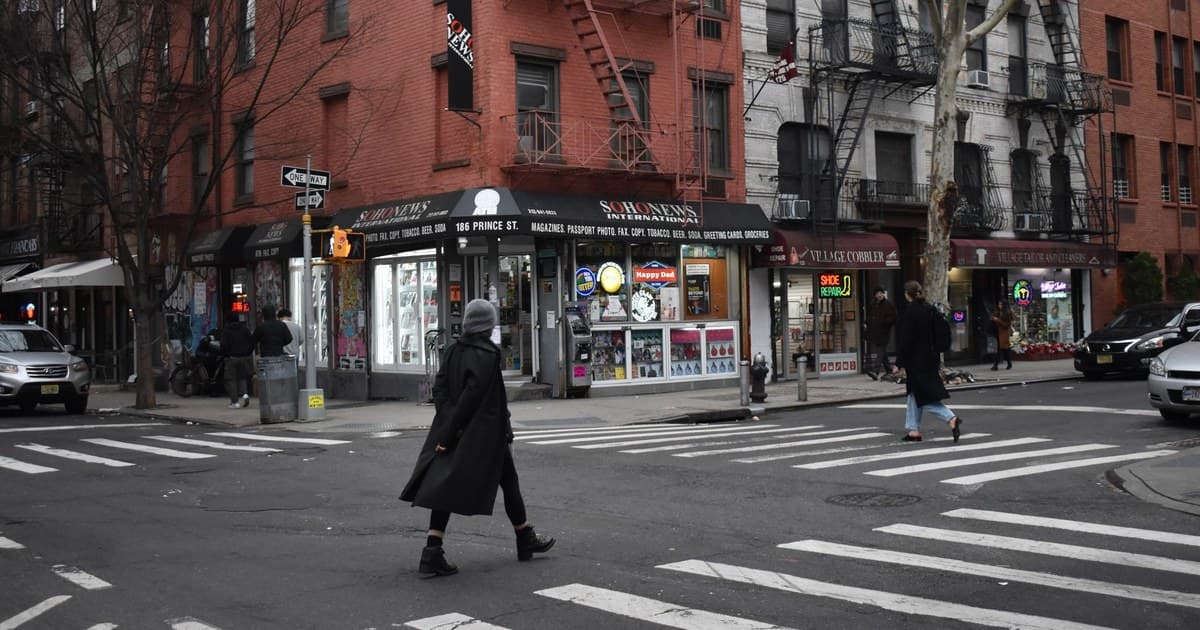
SoHo and the Lower East Side track similarly. A SoHo or LES resident is generally within 10 minutes of a licensed dispensary. Walking is the default; delivery is the convenience override.
Midtown is denser in shops than people expect, but Midtown foot traffic is also brutal at peak hours. The 10-block walk that takes 12 minutes at 11pm takes 25 minutes at 6pm. Delivery starts to make sense as the day stretches on.
The Upper East Side and Upper West Side are thinner. Licensed retail exists, but residents may be 15 to 25 minutes from the nearest shop on foot. This is the zone where delivery shifts from convenience to a practical default.
Harlem, Inwood, and Washington Heights are the thinnest. Licensed shops are concentrated below 110th. For residents above that line, delivery isn't a preference; it's often the only OCM-licensed option that doesn't require a deliberate trip. The directory at /dispensaries/in/new-york is the right starting point.
FiDi sits in a similar bracket. There are fewer named licensed shops than the volume of residents and workers would suggest. Walking is possible; delivery is faster.
Money: walking vs. delivery cost reality
The cost comparison isn't only dollars.
Delivery fees in Manhattan generally land in the $5 to $15 range, depending on the service, the order size, and the distance. A tip on top is standard, and $5 to $10 is the cultural floor for cannabis drivers, who are doing the same job as any other delivery worker while handling a higher-stakes product. Total delivery markup: $10 to $25 per order on the realistic end.
Walking has no fee. It has a time cost. A round trip to a 10-minute-away dispensary, with 15 to 20 minutes inside picking products, is roughly an hour. For an adult whose hourly opportunity cost is meaningful, that's not free either.
The math: if a person's hour is worth more than $25, delivery is the rational call for routine restocks. If a person enjoys the walk, the shop, and the browse, walking is paying for entertainment that delivery doesn't include.
In-store specials can swing the equation. A 20% flower-of-the-week discount can easily outpace a $15 delivery fee. Checking shop social channels before deciding is the move.
Where to shop: the named-licensed-shop file
A short file of OCM-licensed Manhattan shops worth knowing, by neighborhood. All listings should be cross-checked against the OCM verification system at cannabis.ny.gov before a first visit.
- Chelsea / Flatiron — Happy Munkey, Chelsea Cannabis Co., and SOFACLUB Cannabis cover the corridor. Walking between them is realistic on a weekend exploration.
- SoHo — Elevate Soho Cannabis is the neighborhood anchor.
- West Village / Hudson Square — Lighthouse Cannabis serves the west side below 14th.
- Greenwich Village — Blue Forest Farms Dispensary is the named option for the NYU-adjacent stretch.
- East Village / Lower East Side — Dazed and The Hootch sit in the LES/East Village zone. Either is a short walk from most points below Houston east of Broadway.
- Midtown — THE HERBAL CARE THC handles the central Midtown corridor.
- Murray Hill / Midtown East — Just A Little Higher Murray Hill anchors the east side of Midtown.
- Late-night Midtown — MIDNIGHT MOON is the option for the after-hours window.
- Upper East and Upper West — Tetra is the closest named licensed anchor for uptown residents on either side.
For neighborhoods not covered above, the full directory lives at /dispensaries/in/new-york.
The walking-delivery hybrid: building a routine
The smart routine isn't a binary. It's a calendar.
Weekend walks. Saturday and Sunday afternoons are when discovery makes sense. A new shop, a new product line, a budtender conversation that gets remembered. This is when the in-store-only specials get caught and the next month's regular product gets identified.
Weeknight deliveries. After 7pm on a Tuesday, the math collapses toward delivery. The order is known. The product is known. The time saved is real.
Monthly audit. Every four to six weeks, walk to a different shop. Even regulars benefit from comparison shopping, especially as the licensed market matures and pricing shifts. New brands enter the New York market constantly. The walking visit catches them before the delivery menu does.
The hybrid covers the upside of both routes without locking a consumer into the limits of either.
Compliance: the OCM QR and the licensed-only frame
New York legalized adult-use cannabis in 2021. State law prohibits cannabis consumption on state-owned land and in public spaces.
Every legitimate New York dispensary, whether walked into or ordered from, holds a license issued by the Office of Cannabis Management. The OCM runs the verification system at cannabis.ny.gov, and every licensed shop displays an OCM QR code at the entrance. Licensed delivery vehicles carry the same QR for in-person verification at the door. Scanning that code is the 10-second check that separates a legal purchase from an unlicensed one.
Storefronts without a visible OCM QR are not licensed retailers, regardless of how legitimate the signage looks. The unlicensed-storefront problem in New York City has been documented at length; the short version is that a green cross and a glass jar of flower are not a license.
Adults 21 and over with a valid government ID are the only customers a licensed shop or delivery service can serve.
FAQ
What's the average cannabis delivery time in Manhattan?
Most OCM-licensed delivery services in Manhattan quote a 30- to 90-minute window, depending on neighborhood, time of day, and order volume. Midtown and downtown windows tend to be shorter; uptown windows can run longer at peak hours. Same-day delivery is the standard expectation in 2026.
Should I tip my cannabis delivery driver?
Yes. Cannabis drivers handle the same work as any other delivery role, with the added compliance burden of ID verification and licensed-product handoff. A $5 minimum is reasonable for small orders; $10 or more is appropriate for larger orders or longer-distance drops. Cash tips are welcomed.
What's the best Manhattan dispensary to walk to from Times Square?
Walking from Times Square, the central Midtown options include THE HERBAL CARE THC. After hours, MIDNIGHT MOON is the named late-night Midtown option. Both should be verified against the OCM system at cannabis.ny.gov before a first visit.
How do I know a Manhattan dispensary is actually licensed?
Every OCM-licensed shop displays an Office of Cannabis Management QR code at the entrance. Scanning it confirms the license against the state registry. The same verification works for delivery vehicles. Unlicensed storefronts may look legitimate but cannot legally sell adult-use cannabis in New York.
Is it cheaper to walk to a Manhattan dispensary than order delivery?
Walking has no fee, but it has a time cost. Delivery fees plus tip generally run $10 to $25 per order. For routine restocks of known products, delivery often wins on net cost when an hour of time is valued realistically. For shoppers chasing in-store specials, walking can come out ahead.