

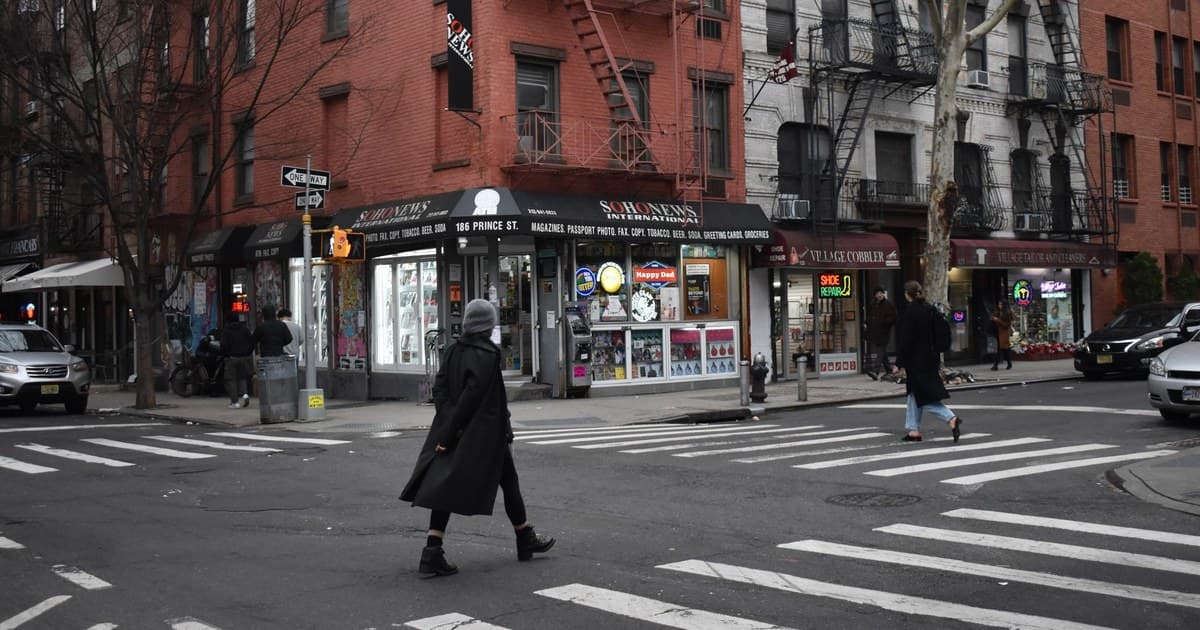
The first legal adult-use sale in New York happened on December 29, 2022, at a shop on Broadway near Astor Place, on the NoHo edge of the East Village. Several years on, Manhattan has a growing number of licensed counters and a stubborn population of unlicensed ones, and the difference between them is not visible from the sidewalk. The process inside a licensed shop, though, is the same everywhere. Here it is in order.
Step one: confirm the shop is licensed
Every licensed dispensary in New York has to post the Office of Cannabis Management's verification sticker, a QR code near the main entrance. Scan it and it resolves to the state's list of licensed retailers. If there is no sticker, or the QR code goes somewhere other than the state's site, walk on.
Verify licensed status via the OCM QR code at cannabis.ny.gov. The same site has a dispensary location verification page for checking an address before leaving home, which is the faster move for anyone planning around a specific neighborhood.
The unlicensed shops tend to give themselves away in other ways too: neon, a menu that includes things no licensed shop can sell, and no interest in your ID. None of these is proof, which is why the QR code exists.
Step two: the ID
Adult-use cannabis is for adults 21+, and a licensed shop checks every customer. The state's list of acceptable identification:
- A valid federal, state or local government ID with your age and photo, including IDNYC
- A driver's license or non-driver ID from any U.S. state, territory or the District of Columbia, or from a Canadian province
- A passport from the United States or any other country
- A U.S. armed forces ID
There is no residency requirement. A visitor from Ohio or Osaka buys on the same terms as someone who lives on the block. The ID has to be valid, so an expired card won't pass.
Step three: what one purchase can hold
The limit is up to three ounces of cannabis flower and up to 24 grams of concentrated cannabis in a day. Concentrated cannabis is the category that catches people out: it covers oils, tinctures, vapes and edibles, not only the products labeled as concentrates. Shops may set lower limits on specific items when inventory runs short.
The same three ounces and 24 grams are the public possession limits for adults 21+, which makes the purchase ceiling and the carry ceiling the same number.
Edibles get their own word of caution: the onset is slower than most first-time buyers expect. Start low, go slow, and resist a second serving until the first has had its full window.
Step four: the tax
Adult-use cannabis in New York carries a 13% retail tax, split into a 9% state tax and a 4% local tax, both shown on the receipt. It replaces ordinary sales tax rather than stacking on top of it.
Where the money goes, according to the state: the 9% supports statewide education, substance-use programs and community reinvestment, and the 4% stays with the local government where the sale happens. There is also a 9% wholesale excise paid upstream by the distributor, which is built into the shelf price rather than added at the register.
The result is that the price on the menu and the price at the register differ by 13%, and a shop that quotes a total with no tax line is a shop worth a second look.
Step five: the receipt
A licensed receipt is a small compliance document. The state's own guide to reading one lists:
- The dispensary's name, address, phone number and license number
- The date and time of the sale, the invoice number and the employee's name
- Each product's form, name, quantity and price
- A separate line for each tax
Keep it until you are home. It is the simplest proof that the product came from a licensed source.
Step six: the package
Regulated products carry the state's universal symbol on the packaging, plus a QR code or URL that leads to the certificate of analysis, the lab report showing the product was tested. A product with neither did not come through the licensed system, whatever the shop says.
If you are ordering instead
Delivery from a licensed dispensary follows its own short list of rules, which the state publishes for consumers:
- Prepaid only. Online or by phone at the time of the order. Couriers cannot take cash.
- ID at the door. The courier checks ID and collects a signature for every order. Someone else 21+ can accept it, but they show ID too.
- Addresses only. Residential properties, short- and long-term residences and private businesses in New York State. Never a park, a public building, a school, a house of worship or a car.
- Store hours. Deliveries happen only while the dispensary is open, and it may charge a fee.
The city's licensed retailers, with neighborhoods, are in the dispensary directory.
After the counter
Buying legally does not make every location legal for consumption. Adults may smoke or vape cannabis in most places where tobacco smoking is allowed, which in practice means a private residence whose lease permits it. Cars, restaurants and their patios, other businesses and federal property are excluded, and New York state law prohibits cannabis consumption on state-owned land and in public spaces. Landlords and hotels can ban smoking on their premises.
Two further rules that surprise people. Giving cannabis to another adult 21+ within the limits is legal; "gifting" it alongside a purchase of something else, the old T-shirt-and-a-bag trick, is not. And New York's legalization ends at the state line: cannabis remains illegal under federal law, so carrying it out of state or through an airport is outside anything the state can authorize.